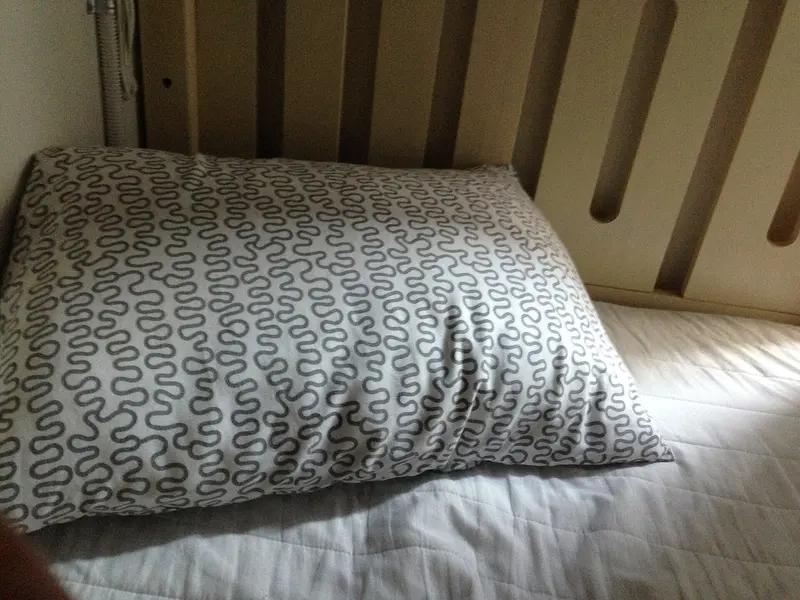
A pillow’s job is simple to describe: Bed Advice UK says a good pillow should hold your head in line with your shoulders and spine, much as they are when you stand upright. Getting there depends far more on how you sleep than on what the pillow costs.
Height: match it to how you sleep
- Side sleepers need the most height, to fill the gap between the mattress and the head. Bed Advice UK says you’ll need a thicker pillow, or two thinner ones, if you sleep on your side.
- Back sleepers need less height.
- Front sleepers. Bed Advice UK advises against sleeping on your front because it strains the neck, and the NHS advice for neck pain says the same.
Too much or too little both cause problems. Bed Advice UK explains that too many pillows push the head up and crease the top of the neck, while a pillow that is too low or thin lets the head drop and creases the underside. The NHS advice for neck pain is to use a low, firm pillow and keep your head at the same height as the rest of your body.
Pillow and mattress work together, so our firmness by sleeping position guide is worth reading alongside this one.
Firm or soft?
Bed Advice UK says a pillow that is too soft lets the head flop and curves the neck, while one that is too hard can leave your neck stiff. A good pillow should keep its shape and support you all night.
The fillings
| Filling | What Bed Advice UK says |
|---|---|
| Polyester (synthetic, often called hollowfibre) | The most popular kind, from very soft to very firm and in a wide price range. Better-quality ones can be machine washed. |
| Feather and down | A soft, luxurious feel and good durability, and many wash well. The more down, the softer and dearer. Cheap feathers can lose their bounce and may smell. |
| Foam and latex | Hold their shape well and are considered hypo-allergenic, but tend to be firm with a noticeable bounce. |
| Shaped “neck care” pillows | Usually foam or latex, moulded to support the neck, and often used with a softer pillow. |
Two pillows we list show the range: Silentnight’s Anti-Allergy pillows are hollowfibre, and IKEA’s KLUBBSPORRE is a shaped memory foam pillow. Each product page has the maker’s details.
Allergies, asthma and eczema
Foam and latex pillows are considered hypo-allergenic, but Bed Advice UK recommends special barrier covers for anyone with asthma, other breathing problems or eczema. It also warns that an old, unwashed pillow can build up skin scales, mould, dust mites and their droppings. Our article on dust mites and washing bedding explains wash temperatures and allergy covers.
Try before you buy
Bed Advice UK suggests testing a pillow lying on your side, in the position you sleep in, and asking someone to check whether your neck and upper back are in a straight line.
Washing pillows
- Check the care label first. Bed Advice UK says cotton, down and synthetic pillows are generally safe to machine wash, but foam pillows should be wiped clean rather than washed.
- How often. Bed Advice UK suggests washing feather and polyester pillows at least three times a year, and cleaning foam pillows every two to three months.
- In the machine. It suggests a gentle cycle with a mild detergent unless the label says otherwise, and washing two pillows at a time to balance the drum.
- Drying. Tumble dry on a low heat or air dry somewhere well ventilated, as the label allows.
- Use a protector. Bed Advice UK says a pillow protector helps the pillow last longer by keeping dirt and oils out.
When to replace a pillow
Bed Advice UK says to replace pillows at least every two or three years, and sooner if they have lost their height or become lumpy, discoloured or misshapen. An old pillow doesn’t have to go to landfill: it suggests recycling it or using it as a kneeling pad.