Most mattresses fall into two groups: sprung, with a spring unit at the core, and non-sprung, made from foam or latex. The National Bed Federation (NBF) says "the majority of mattresses in the UK have spring interiors".


Open coil (Bonnell)
Springs arranged in rows and joined to each other top and bottom by spiral wire, with a rod strengthening the edge. The NBF says there are usually at least 325 coils in a 150cm (king) mattress and that open coil mattresses are "priced from budget to mid-range". Because the springs are linked, movement can travel across the bed — IKEA notes that with its Bonnell mattresses "partners can feel your movements", which is why open coil is often chosen for single and guest beds.
Continuous coil
A single length of wire "knitted" into a run of springs. The NBF says this gives a higher spring count and a more responsive feel than open coil, priced mid-market. Silentnight's Miracoil is a continuous coil system.
Pocket springs
Small springs, each sewn into its own fabric pocket so it moves independently. The NBF says pocket springs "help to eliminate roll-together", and that spring counts typically range from 600–800 up to 2,500, sometimes 3,000 or 4,000. Pocket sprung mattresses are often more expensive. A bigger number is not automatically better — compare the same size, because makers often quote the count for a king.
Memory foam and other foams
Most foam mattresses are made from layers of foam of different densities. Memory foam (visco-elastic foam) "responds to individual shape and pressure" and has "good pressure-relieving properties", says the NBF — but it also warns that cheap offers "might not have enough density or be thick enough". Foam is a good insulator, so some people find it warmer. Foam mattresses suit slatted bases and adjustable beds, and many are sold rolled in a box.
Latex
Latex foam is made from the sap of the rubber tree (many mattresses use a blend). The NBF describes its "distinctive, resilient feel": it "recovers its shape immediately when pressure is removed", where memory foam sinks slowly.
Hybrid
A hybrid combines a spring unit — usually pocket springs — with foam or latex comfort layers on top. The NBF doesn't define the term, so check what's inside: IKEA's � NNELAND, for example, layers memory foam and high-resilience foam over mini pocket springs.
The outside: quilted or tufted
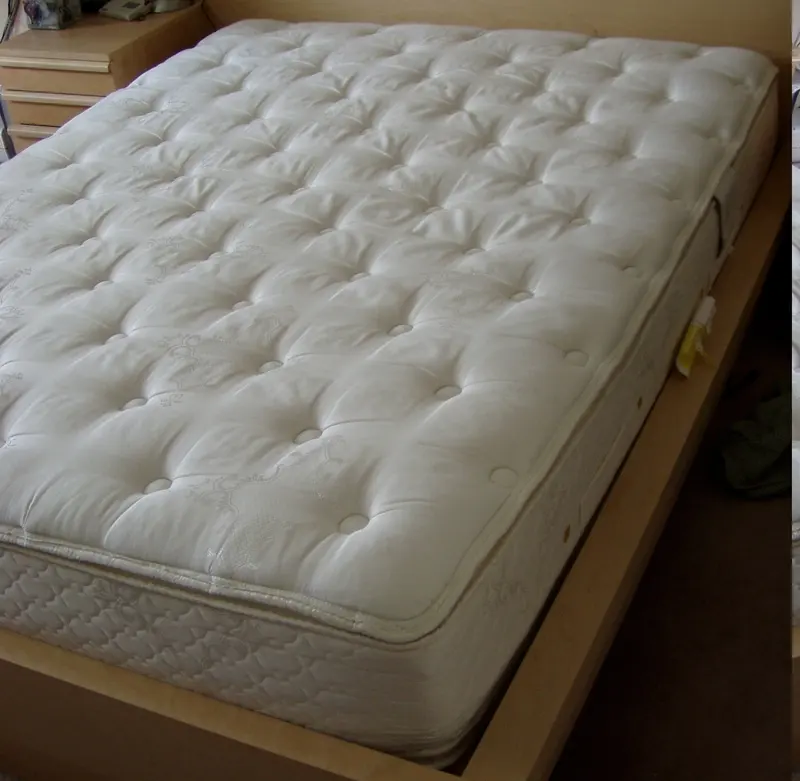
The cover is called the ticking. Quilting stitches the cover to the top fillings for a smoother surface; tufting passes tapes right through the mattress to stop loose fillings moving. The NBF says choosing between them is personal preference.
At a glance
| Type | How it's built | Worth knowing |
|---|---|---|
| Open coil | Rows of springs joined by wire | Budget to mid-range; movement can travel across the bed |
| Continuous coil | One length of wire formed into springs | Mid-market |
| Pocket sprung | Springs in individual pockets | Less roll-together; often costs more |
| Memory foam | Layers of foam including visco-elastic | Moulds to you; often rolled; can feel warmer |
| Latex | Foam from rubber-tree sap or blends | Springy, recovers shape straight away |
| Hybrid | Springs plus foam or latex layers | Check what the layers actually are |
Related guide: Choosing mattress firmness by sleeping position