Cot mattresses
The Lullaby Trust's advice is to "use a firm, flat, waterproof mattress in good condition":
- Firm and flat, with no raised or cushioned edges or sides. Your baby's head should sink no more than a few millimetres.
- Waterproof — or with a waterproof cover — so it can be wiped clean.
- The right size, fitting the cot or Moses basket properly with no gaps.
- A clear cot: no pillows, duvets, quilts, bumpers, pods, nests or sheepskins.
It recommends a new mattress for each baby where possible. If you use a second-hand one, it should have no rips or tears, no water damage, no sagging, fit well with no gaps, and carry a fire-resistant label.
The standard The Lullaby Trust lists for cot, travel cot and crib mattresses is BS EN 16890:2017+A1:2021 (and BS EN 716-1:2017 for cots). It also points out that there is no safety standard related to sudden infant death syndrome (SIDS), so a product meeting a standard isn't automatically the safest choice.
Moving to a big bed
The NBF says children usually move out of a cot "between 18 months and three years". A small single (75 × 190cm) or single (90 × 190cm) is the usual first bed — see our size guide.
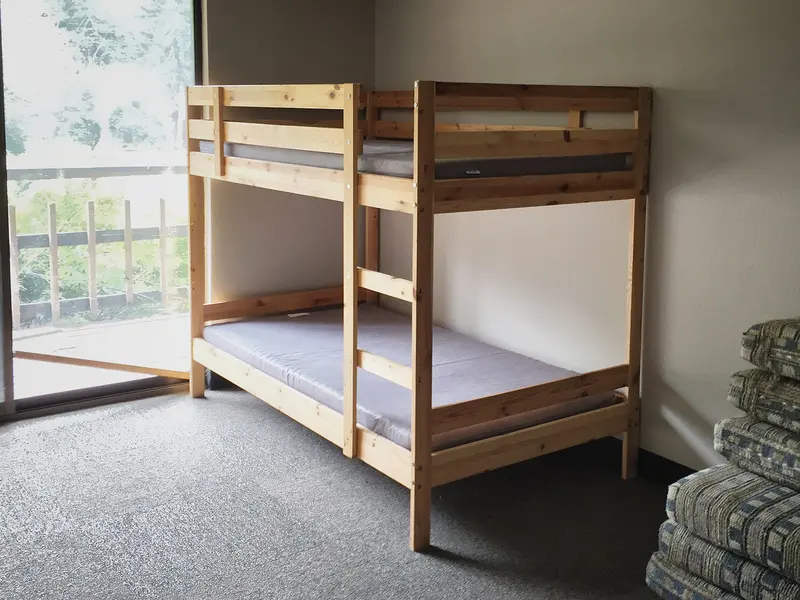
Bunk beds
The NBF's bunk bed checklist:
- Look for beds that meet the UK safety standard BS EN 747.
- The bunk should be thoroughly stable.
- There should be two guard rails on the upper bunk, even if it's going against a wall.
- Any ladder must be firmly secured.
- Catches and fixings shouldn't be within reach of small fingers.
- There must be no gaps large enough for a child's head to get stuck.
- Children under six are not advised to use the top bunk. IKEA says the same on its bunk and loft beds: they're "not suitable for children under 6 years due to the risk of injury from falls".
Use the mattress size the bunk was designed for — many, including IKEA's, take EU 90 × 200cm mattresses rather than UK singles — and stay within the maximum mattress thickness the maker gives.
Cabin beds, mid sleepers and high sleepers
- Check the maker's age guidance; IKEA's high and loft beds are not for under-sixes.
- Measure your ceiling: IKEA's SM�
STAD loft bed, for example, needs at least 240cm.
- Mind the gap to the wall. For its KURA bed, IKEA says the gap between bed and wall "must always be less than 6.5 cm or greater than 23 cm" so a child's head can't get stuck.
Choosing a child's mattress
- The NBF says "a medium mattress is the most appropriate level of firmness for a child" generally, softer or firmer for particularly light or heavy children.
- "Mattresses containing memory foam are generally not recommended for young children."
- Hypoallergenic fillings may be needed for a child with asthma, eczema or rhinitis.
- Avoid second-hand and hand-me-down mattresses, and check for labels showing compliance with UK fire safety rules.
- Expect to change the mattress (and maybe the bed) during big growth spurts.
Looking after it
Use a washable mattress protector, don't let children jump on the bed, rotate and air the mattress as the maker says, and clean spills straight away (NBF).
Examples: kids' mattresses
See all 2
Silentnight Kids' mattresses
Healthy Growth Astro Eco Comfort Pocket Mattress
600 Mirapocket springs + EcoComfort fibres
Sizes: Single
Sleepeezee Kids' mattresses
Glow Kids Mattress
450 pocket springs + polyester and eco fibre layers
Sizes: Single · Small double
We don't sell these products — details come from the makers' websites. Check the retailer for current prices.