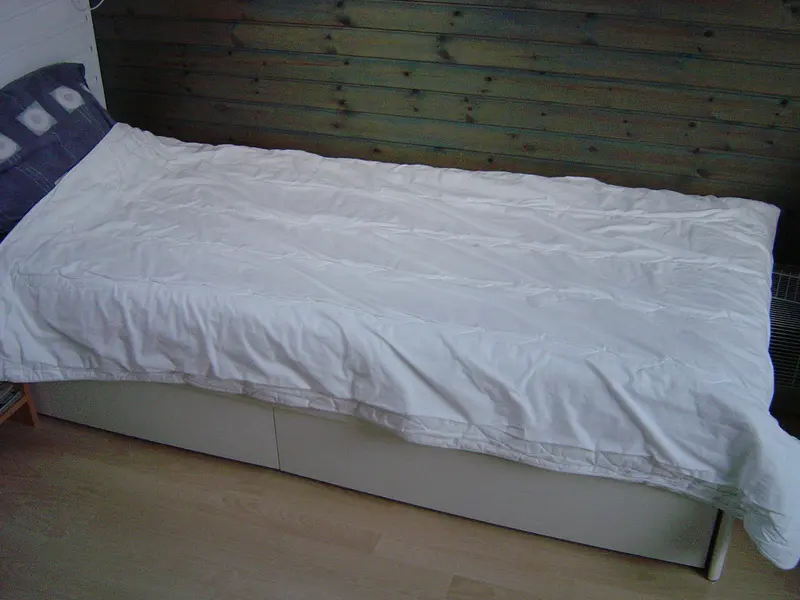
When the nights turn cold, most of us reach for a thicker duvet or an extra blanket. That works, but a little understanding of how bedding keeps you warm can save money and stop you waking up too hot at 3am instead.
This article covers adults and older children. Babies have their own, quite different rules — see the section near the end and our article on babies sleeping away from home.
Start with the room
The NHS's cold-weather advice is to heat the rooms you use regularly, including the bedroom, to at least 18°C if you can, and to keep bedroom windows closed on winter nights. It singles out people aged 65 and over, young children, people with long-term health conditions, disabled people, pregnant women and anyone who can't afford to heat their home as more vulnerable to the cold. If that's you or someone you live with, a warm bedroom matters more than any duvet.
Bedding can't make up for a very cold room, but it can make a cool room comfortable. Dormeo's duvet guide suggests a bedroom of roughly 18 to 21 degrees overnight.
What tog actually measures
A tog rating is a measure of how well a duvet holds in heat: the higher the number, the warmer it is. Dormeo describes a range running from 1 tog (very light) up to 15 (the warmest), with most duvets sold between 4.5 and 13.5 tog.
Two things are easy to miss:
- Thicker isn't automatically warmer. Dormeo points out that the filling decides the insulation, so a heavy, bulky duvet can have a lower tog than a lighter one.
- Tog is about the duvet, not you. The same 13.5 tog can feel stifling to someone who sleeps hot and fine to someone who feels the cold.
Which tog for winter?
Dormeo suggests 13.5 tog for the colder months, going up to 15 tog for an especially cold bedroom. If you're unsure, it suggests a medium 10.5 tog as an all-round choice, which you can top up on cold nights.
That "top up" idea is often more useful than buying the warmest duvet you can find. A lighter duvet plus a throw or quilt lets you add or remove a layer as the weather changes, rather than kicking off a 15 tog at midnight.
Your mattress plays a part
Some mattresses feel warmer than others. Dormeo notes that memory foam can hold on to more heat, so people who sleep on foam may manage with a lighter duvet for much of the year. Sprung mattresses, especially pocket sprung, have more air moving through them. Our guide to mattress types explains how each is built.
A topper can change how warm a bed feels too, as well as how soft it is — see how long a mattress lasts for when a topper helps and when it's just covering up a worn-out mattress, and cheap mattress toppers: what to check for choosing one.
Layering that works
A few practical habits help on cold nights:
- Layer on top, not only underneath. Warm air is lost upwards, so a throw over the duvet traps more heat than you might expect.
- Use a mattress protector and a cotton or brushed-cotton sheet. They make the bed feel less cold to get into, and the protector keeps the mattress clean.
- Keep the bed away from cold outside walls if you can. GOV.UK's damp and mould guidance advises leaving a gap between furniture and outside walls so air can circulate — which also helps stop condensation forming behind the headboard. More in our article on damp and condensation in the bedroom.
- Warm the bed safely. A hot water bottle or electric blanket can take the chill off, but each has its own safety rules — and they should never be used together. Read electric blankets and hot water bottles: a winter safety check before you dig them out.
Children and babies
For children, Dormeo suggests a very light duvet of no more than 4 tog from about the age of one, adding blankets as needed, and considering a warmer duvet after about three.
Babies under 12 months shouldn't have a duvet at all. The Lullaby Trust recommends a room of 16 to 20°C, light bedding or a well-fitting baby sleeping bag, no hats indoors, and checking a baby's chest or the back of the neck (not hands or feet) to see whether they're too warm. It says heating left on overnight should be kept low and no higher than 20°C.
If you're buying new bedding
Duvets and pillows come in the same UK bed sizes as mattresses, so check yours in our size guide before ordering. If allergies are an issue, our article on dust mites and washing bedding explains what washable bedding and covers can and can't do.

Silentnight Duvets & mattress protectors
Anti-Allergy Duvet
Anti-allergy hollowfibre duvet
Sizes: Single · Double · King

We don't sell these products — details come from the makers' websites. Check the retailer for current prices.
In short
Get the room as warm as you reasonably can, choose a duvet that suits the room rather than the thickest one on the shelf, and add removable layers for the coldest nights. If the cold is affecting your health, or you're worried about an older relative, the NHS page listed below has advice on getting help with heating costs.